General information
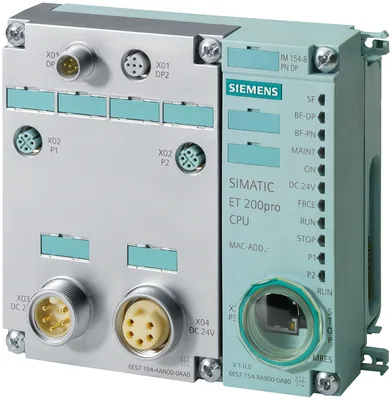
Product type designationIM 154-8 PN/DP CPU
HW functional status01
Firmware versionV3.2
Product function
Isochronous modeYes; Via PROFIBUS DP or PROFINET interface
Engineering with
Programming packageSTEP 7 V5.5 or higher
Supply voltage
Rated value (DC)24 V
external protection for power supply lines (recommendation)MCB 24 V DC / 16 A with tripping characteristic Type B and C (see ET 200pro manual)
Load voltage L+
Rated value (DC)24 V
permissible range, lower limit (DC)20.4 V
permissible range, upper limit (DC)28.8 V
Reverse polarity protectionYes
Input current
Current consumption, typ.350 mA
Current consumption (in no-load operation), typ.250 mA; Typical, current consumption for CPU in STOP state
Inrush current, typ.2 A
I²t0.25 A²·s; Typical
Power loss
Power loss, typ.8.5 W
Work memory
integrated384 kbyte
expandableNo
Load memory
Plug-in (MMC), max.8 Mbyte
Data management on MMC (after last programming), min.10 a
Backup
presentYes; Guaranteed by MMC (maintenance-free)
without batteryYes; Program and data
CPU processing times
for bit operations, typ.0.05 µs
for word operations, typ.0.09 µs
for fixed point arithmetic, typ.0.12 µs
for floating point arithmetic, typ.0.45 µs
CPU-blocks
Number of elements (total)1 024; (DBs, FCs, FBs); the maximum number of loadable blocks can be reduced by the MMC used.
DB
Number, max.1 024; Number range: 1 to 16000
Size, max.64 kbyte
FB
Number, max.1 024; Number range: 0 to 7999
Size, max.64 kbyte
FC
Number, max.1 024; Number range: 0 to 7999
Size, max.64 kbyte
OB
Size, max.64 kbyte
Number of free cycle OBs1; OB 1
Number of time alarm OBs1; OB 10
Number of delay alarm OBs2; OB 20, 21
Number of cyclic interrupt OBs4; OB 32, 33, 34, 35
Number of process alarm OBs1; OB 40
Number of DPV1 alarm OBs3; OB 55, 56, 57
Number of isochronous mode OBs1; OB 61
Number of startup OBs1; OB 100
Number of asynchronous error OBs6; OB 80, 82, 83, 85, 86, 87 (OB83 only for centralized I/O and PROFINET IO)
Number of synchronous error OBs2; OB 121, 122
Nesting depth
per priority class16
additional within an error OB4
S7 counter
Number256
Retentivity
— adjustableYes
— presetZ 0 to Z 7
Counting range
— can be setYes
— lower limit0
— upper limit999
IEC counter
TypeSFB
NumberUnlimited (limited only by RAM capacity)
S7 timer
Number256
Retentivity
— adjustableYes
— presetNo retentivity
Time range
— lower limit10 ms
— upper limit9 990 s
IEC timer
TypeSFB
NumberUnlimited (limited only by RAM capacity)
Data areas and their retentivity
Retentive data area (incl. timers, counters, flags), max.128 kbyte
Flag
Size, max.2 048 byte
Retentivity availableYes; MB 0 to MB 2 047
Retentivity presetMB 0 to MB 15
Number of clock memories8
Data blocks
Retentivity adjustableYes; via non-retain property on DB
Retentivity presetYes
Local data
per priority class, max.32 768 byte; Max. 2048 bytes per block
I/O address area
Inputs2 048 byte
Outputs2 048 byte
of which distributed
— Inputs2 048 byte
— Outputs2 048 byte
Process image
Inputs, adjustable2 048 byte
Outputs, adjustable2 048 byte
Inputs, default128 byte
Outputs, default128 byte
Subprocess images
Number of subprocess images, max.1; With PROFINET IO, the length of the user data is limited to 1600 bytes
Digital channels
Inputs16 384
— of which central128
Outputs16 384
— of which central64
Analog channels
Inputs1 024
— of which central64
Outputs1 024
— of which central64
Number of DP masters
integrated1
Rack
Racks, max.1
Modules per rack, max.16; Expansion width max. 1 m
Clock
Hardware clock (real-time)Yes
retentive and synchronizableYes
Backup time6 wk; At 40 °C ambient temperature
Deviation per day, max.10 s; Typ.: 2 s
Operating hours counter
Number1
Number/Number range0
Range of values0 to 2^31 hours (when using SFC 101)
Granularity1 h
retentiveYes; Must be restarted at each restart
Clock synchronization
supportedYes
to MPI, masterYes
on MPI, deviceYes
to DP, masterYes; With DP slave only slave clock
on DP, deviceYes
on Ethernet via NTPYes; As client
Interfaces
Interfaces/bus type1x MPI/PROFIBUS DP, 1x PROFINET (3 ports)
1. Interface
Interface typeIntegrated RS 485 interface
IsolatedYes
Interface types
RS 485Yes
Output current of the interface, max.May only be used for external terminating resistor
Design of the connection2x M12 B-coded
Protocols
MPIYes
PROFIBUS DP masterYes
PROFIBUS DP deviceYes
Point-to-point connectionNo
MPI
Transmission rate, max.12 Mbit/s
Services
— PG/OP communicationYes
— RoutingYes
— Global data communicationYes
— S7 basic communicationYes
— S7 communicationYes
— S7 communication, as clientNo
— S7 communication, as serverYes
PROFIBUS DP master
Transmission rate, max.12 Mbit/s
max. number of DP devices124
Services
— PG/OP communicationYes
— RoutingYes
— Global data communicationNo
— S7 basic communicationYes; I blocks only
— S7 communicationYes
— S7 communication, as clientNo
— S7 communication, as serverYes; Connection configured on one side only
— EquidistanceYes
— Isochronous modeYes; OB 61 - isochronous mode is possible either on DP or PROFINET IO (not simultaneously)
— SYNC/FREEZEYes
— activation/deactivation of DP devicesYes
— Direct data exchange (slave-to-slave communication)Yes; as subscriber
— DPV1Yes
Address area
— Inputs, max.2 048 byte
— Outputs, max.2 048 byte
User data per DP device
— Inputs, max.244 byte
— Outputs, max.244 byte
PROFIBUS DP device
Transmission rate, max.12 Mbit/s
automatic baud rate searchYes; only with passive interface
Address area, max.32
User data per address area, max.32 byte
Services
— RoutingYes; with interface active
— Global data communicationNo
— S7 basic communicationNo
— S7 communicationYes
— S7 communication, as clientNo
— S7 communication, as serverYes; Connection configured on one side only
— Direct data exchange (slave-to-slave communication)Yes
— DPV1No
Transfer memory
— Inputs244 byte
— Outputs244 byte
2. Interface
Interface typePROFINET
IsolatedYes; Galvanic isolation for P3 is implemented in IM154-8, for P1 and P2 in CM
automatic detection of transmission rateYes; 10/100 Mbit/s
AutonegotiationYes
AutocrossingYes
Change of IP address at runtime, supportedYes
Interface types
Number of ports3
integrated switchYes
Design of the connectionEthernet (2x M12 D-coded; 1x RJ45)
Protocols
MPINo
PROFINET IO ControllerYes; Also simultaneously with IO-Device functionality
PROFINET IO DeviceYes; Also simultaneously with IO Controller functionality
PROFINET CBAYes
PROFIBUS DP masterNo
PROFIBUS DP deviceNo
Open IE communicationYes; Via TCP/IP, ISO on TCP, and UDP
Web serverYes
Media redundancyYes
PROFINET IO Controller
Transmission rate, max.100 Mbit/s
Services
— PG/OP communicationYes
— RoutingYes
— S7 communicationYes; With loadable FBs, max. configurable connections: 14, max. number of instances: 32
— Isochronous modeYes; OB 61 - isochronous mode is possible either on DP or PROFINET IO (not simultaneously)
— IRTYes
— Shared deviceYes
— Prioritized startupYes
— Number of IO devices with prioritized startup, max.32
— Number of connectable IO Devices, max.128
— Of which IO devices with IRT, max.64
— of which in line, max.64
— Number of IO Devices with IRT and the option "high flexibility"128
— of which in line, max.61
— Number of connectable IO Devices for RT, max.128
— of which in line, max.128
— Activation/deactivation of IO DevicesYes
— Number of IO Devices that can be simultaneously activated/deactivated, max.8
— IO Devices changing during operation (partner ports), supportedYes
— Number of IO Devices per tool, max.8
— Device replacement without swap mediumYes
— Send cycles250 μs, 500 μs,1 ms; 2 ms, 4 ms (not in the case of IRT with "high flexibility" option)
— Updating time250 µs to 512 ms (depending on the operating mode, see "IM 154-8 CPU Interface Module" operating instructions for more details)
Address area
— Inputs, max.2 048 byte
— Outputs, max.2 048 byte
— User data consistency, max.1 024 byte
Services
— PG/OP communicationYes
— RoutingYes
— S7 communicationYes; With loadable FBs, max. configurable connections: 14, max. number of instances: 32
— Isochronous modeNo
— IRTYes
— PROFIenergyYes; With SFB 73 / 74 prepared for loadable PROFIenergy standard FB for I-Device
— Shared deviceYes
— Number of IO Controllers with shared device, max.2
Transfer memory
— Inputs, max.1 440 byte; Per IO Controller with shared device
— Outputs, max.1 440 byte; Per IO Controller with shared device
Submodules
— Number, max.64
— User data per submodule, max.1 024 byte
PROFINET CBA
acyclic transmissionYes
cyclic transmissionYes
Open IE communication
Number of connections, max.8
Local port numbers used at the system end0, 20, 21, 23, 25, 80, 102, 135, 161, 443, 8080, 34962, 34963, 34964, 65532, 65533, 65534, 65535
Keep-alive function, supportedYes
Media redundancy
— Switchover time on line break, typ.200 ms; PROFINET MRP
— Number of stations in the ring, max.50
SIMATIC communication
S7 routingYes
Open IE communication
TCP/IPYes; via integrated PROFINET interface and loadable FBs
— Number of connections, max.8
— Data length, max.32 768 byte; 1 460 bytes with connection type 01H; 32 768 bytes with connection type 11H
— several passive connections per port, supportedYes
ISO-on-TCP (RFC1006)Yes
— Number of connections, max.8
— Data length, max.32 768 byte
UDPYes
— Number of connections, max.8
— Data length, max.1 472 byte
Web server
supportedYes
User-defined websitesYes
Number of HTTP clients5
Communication functions
PG/OP communicationYes
Global data communication
supportedYes
Number of GD loops, max.8
Number of GD packets, max.8
Number of GD packets, transmitter, max.8
Number of GD packets, receiver, max.8
Size of GD packets, max.22 byte
Size of GD packet (of which consistent), max.22 byte
S7 basic communication
supportedYes
User data per job, max.76 byte
User data per job (of which consistent), max.76 byte; 76 bytes (with X_SEND or X_RCV); 64 bytes (with X_PUT or X_GET as server)
S7 communication
supportedYes
as serverYes
as clientYes; via integrated PROFINET interface and loadable FBs
User data per job, max.See online help of STEP 7 (shared parameters of the SFBs/FBs and of the SFCs/FCs of S7 Communication)
PROFINET CBA (at set setpoint communication load)
Setpoint for the CPU communication load50 %
Number of remote interconnection partners32
number of master/device functions30
total of all master/device connections1 000
data length of all incoming master/device connections, max.4 000 byte
data length of all outgoing master/device connections, max.4 000 byte
Number of device-internal and PROFIBUS interconnections500
Data length of device-internal und PROFIBUS interconnections, max.4 000 byte
Data length per connection, max.1 400 byte
Remote interconnections with cyclic transmission
— Transmission frequency: Transmission interval, min.1 ms
— Number of incoming interconnections200
— Number of outgoing interconnections200
— Data length of all incoming interconnections, max.2 000 byte
— Data length of all outgoing interconnections, max.2 000 byte
— Data length per connection, max.450 byte
HMI variables via PROFINET (acyclic)
— Number of stations that can log on for HMI variables (PN OPC/iMap)3; 2x PN OPC/1x iMap
— HMI variable updating500 ms
— Number of HMI variables200
— Data length of all HMI variables, max.2 000 byte
PROFIBUS proxy functionality
— supportedYes
— Number of linked PROFIBUS devices16
— Data length per connection, max.240 byte; Slave-dependent
Number of connections
overall16
usable for PG communication15
— reserved for PG communication1
— adjustable for PG communication, min.1
— adjustable for PG communication, max.15
usable for OP communication15
— reserved for OP communication1
— adjustable for OP communication, min.1
— adjustable for OP communication, max.15
usable for S7 basic communication14
— reserved for S7 basic communication0
— adjustable for S7 basic communication, min.0
— adjustable for S7 basic communication, max.14
usable for routingX1 as MPI: max. 10; X1 as DP master: max. 24; X1 as DP slave (active): max. 14; X2 as PROFINET: 24 max.
S7 message functions
Number of login stations for message functions, max.16; Depending on the configured connections for PG/OP and S7 basic communication
Process diagnostic messagesYes
simultaneously active Alarm_S blocks, max.300
Test commissioning functions
Status blockYes; Up to 2 simultaneously
Single stepYes
Number of breakpoints4
Status/control
Status/control variableYes
VariablesInputs, outputs, memory bits, DB, times, counters
Number of variables, max.30
— of which status variables, max.30
— of which control variables, max.14
Forcing
ForcingYes
Forcing, variablesI/O
Number of variables, max.10
Diagnostic buffer
presentYes
Number of entries, max.500; Only the last 100 entries are retentive at power on/off
— adjustableNo
— preset10
Potential separation
between backplane bus and electronicsNo
between backplane bus and all other circuit componentsYes
between supply and all other circuitsYes
Isolation
Isolation tested withIn general, 707 V DC (type test), Ethernet interface 1 500 V AC (for P1 and P2 on CM, for P3 on IM)
Standards, approvals, certificates
CE markYes
CSA approvalNo
cULusYes
FM approvalNo
RCM (formerly C-TICK)Yes
Configuration software
STEP 7Yes; V5.5 or higher
Programming
Command setsee instruction list
Nesting levels8
System functions (SFC)see instruction list
System function blocks (SFB)see instruction list
Programming language
— LADYes
— FBDYes
— STLYes
— SCLYes
— CFCYes
— GRAPHYes
— HiGraph®Yes
Know-how protection
User program protection/password protectionYes
Block encryptionYes; With S7 block Privacy
Dimensions
Width135 mm
Height130 mm
Depth65 mm; 60 mm without cover for RJ45 socket; 65 mm with cover for RJ45 socket
Weights
Weight, approx.720 g